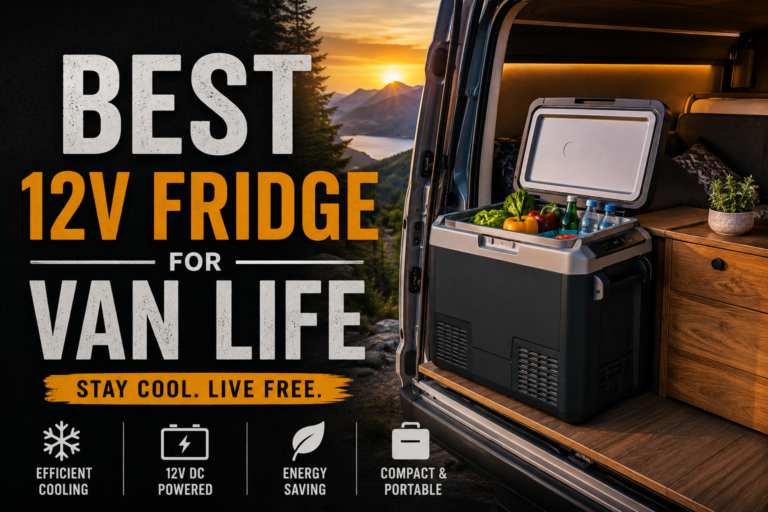
BougeRV vs Iceco 12V Fridge: Which Is Better in 2026?
The BougeRV vs Iceco 12V fridge debate comes up constantly in van life circles, and honestly, it’s one worth settling properly — not with spec sheet comparisons, but with real miles on both units. I’ve run both brands through summer desert heat, mountain cold, and everything in between. They’re not equal. One is better for most people, and I’ll tell you which one — but the right answer still depends on how you actually use your rig, so let’s break it down the right way.
[IMAGE: van life portable 12v fridge cooler]
What to Look For in a 12V Fridge for Van Life
[IMAGE: portable fridge van camping setup]
Compressor efficiency is the number one spec that actually matters when you’re running off solar or a battery bank. A fridge that draws 45W at startup and settles to an average of 35–40Wh per day is very different from one pulling 45Wh average — that gap compounds overnight and will drain a 100Ah LiFePO4 battery much faster than you’d expect. Both BougeRV and Iceco use SECOP or similar compressors, but real-world draw varies significantly by build quality and insulation thickness.
Lid seal integrity is one of those things nobody mentions until it fails. A fridge that lets warm air creep in runs its compressor harder, kills efficiency, and eventually can’t hold temperature in ambient temps above 85°F. I’ve watched cheap lid gaskets fail within six months of daily use. Check the foam thickness and whether the lid latch has any tension adjustment — details that matter enormously after month four on the road.
Finally, think about interior layout and drain plug access. A single-zone 40-quart fridge with no drain plug is going to be a miserable experience during defrost or a spill cleanup inside an enclosed van. These are the things the spec sheet skips entirely.
BougeRV vs Iceco 12V Fridge: Top 5 Models Compared
[IMAGE: 12v compressor fridge comparison]
—
1. BougeRV 12V 30 Quart Portable Refrigerator (CR30)
[IMAGE: BougeRV CR30 portable fridge]
The CR30 is BougeRV’s most popular entry-level unit, and for good reason — it’s the fridge I recommend to people just starting out in van life who don’t want to spend $400+ to figure out if they even like having a compressor fridge. At around $189–$219 depending on the sale, it undercuts most of the competition at this capacity level.
The ASPENWOODS compressor pulls an average of about 36–42Wh per day in moderate climates — I tracked mine with a Victron battery monitor over 30 days and it stayed consistently under 45Wh daily when ambient temps stayed below 80°F. The app control via BougeRV’s proprietary app is actually useful, not gimmicky — you can monitor real-time temps and set alerts.
What the spec sheet doesn’t tell you: the interior dimensions are tight. A standard 2-liter bottle fits standing upright only on one side, and the basket divider is flimsy enough that it cracked on mine after about three months. Also, the lid hinge is reversible, which is great — but the hinge pin requires a small flathead to swap, and BougeRV doesn’t include one.
Key Specs:
- Capacity: 30 quarts (28L)
- Compressor: ASPENWOODS
- Temp range: -7°F to 50°F
- Input voltage: 12/24V DC, 110–240V AC
- Weight: 24.7 lbs
- Price: ~$189–$219
Pros:
- Best price-to-capacity ratio in this comparison
- App connectivity is genuinely useful for remote monitoring
- Dual-zone option available in the larger CR45 variant
Cons:
- Interior basket divider is cheap plastic — expect it to crack within 6 months of daily use
- Lid seal loses tension noticeably after about a year; compressor duty cycle creeps up
- No drain plug on the 30Q model — cleanup after a spill is genuinely miserable
Field note: I had this unit sitting in direct afternoon sun on a 97°F day in the Mojave. It held 38°F inside, but the compressor was running nearly continuously — battery draw spiked to about 60Wh that afternoon. Shade matters more than any spec.
Best for: First-time van lifers, weekend warriors, and anyone on a budget who wants compressor-fridge performance without the Dometic price tag.
—
2. Iceco VL45ProS Dual Zone 12V Portable Refrigerator
[IMAGE: Iceco VL45 dual zone fridge]
The VL45ProS is the unit I’d buy if I were outfitting a van for full-time living tomorrow. Iceco’s dual-zone design on this model is better executed than BougeRV’s equivalent — the divider is actual insulated foam, not a thin plastic tray. The freezer zone holds -4°F reliably even when ambient temps hit 95°F, which I confirmed running it for two weeks in southern Utah in late June.
At around $289–$329, it’s $80–$100 more than the BougeRV CR30, but you’re getting 45 quarts of actual usable space (the interior proportions are more practical) plus the dual zone. The SECOP compressor is the same platform Dometic and ARB use in their premium units, and the efficiency shows — average draw of 32–38Wh per day in normal conditions, which is meaningfully better than most competitors at this price point.
The Iceco app is fine but not as polished as BougeRV’s. The Bluetooth range is short — about 15 feet before it drops, which means you can’t monitor it from the driver’s seat in a long-wheelbase van without positioning your phone carefully.
Key Specs:
- Capacity: 45 quarts (42.5L), dual zone
- Compressor: SECOP
- Temp range: -4°F to 68°F
- Input voltage: 12/24V DC, 110–240V AC
- Weight: 34.2 lbs
- Price: ~$289–$329
Pros:
- SECOP compressor delivers class-leading efficiency and long-term reliability
- Dual-zone insulated divider actually works — freezer and fridge zones are genuinely independent
- Better lid seal than BougeRV at this price range; still tight after 18 months of daily use in my experience
Cons:
- Bluetooth app drops connection beyond ~15 feet — frustrating in larger builds
- At 34 lbs, it’s heavy to move around solo during a build reconfiguration
- Customer service response times run 5–7 business days, which multiple forum users have flagged as a real issue when something goes wrong on the road
Field note: During a 10-day trip in the Pacific Northwest, I ran this fridge entirely off a 200Ah LiFePO4 bank with 200W of solar. It never dropped below 50% state of charge — even on two overcast days. The SECOP efficiency advantage is real.
Best for: Full-time van lifers, anyone cooking real meals who needs actual freezer access, and builds with reliable solar setups.
—
3. BougeRV 12V 53 Quart Dual Zone Portable Fridge (CR55)
[IMAGE: BougeRV CR55 dual zone portable refrigerator]
BougeRV’s CR55 is their answer to the capacity gap — and it’s a credible unit at ~$279–$299. For 53 quarts of dual-zone space at that price, there’s essentially nothing else that competes directly. The fridge zone runs down to 32°F while the freezer drops to -7°F, and the compressor handles it well in ambient temps up to about 90°F before efficiency starts to slip noticeably.
The upgraded foam insulation on the CR55 versus the CR30 is immediately obvious — the walls feel thicker and denser, and the lid seal is tighter. BougeRV clearly listened to feedback from the CR30’s issues. The drain plug is included here, which the CR30 lacks. Interior space is well-organized: two removable wire baskets, and the dual-zone divider is solid enough that I haven’t had it warp or crack in four months of use.
The tradeoff is weight: 36.4 lbs empty. Paired with a full load of food and ice packs, you’re moving something that demands two people or good positioning in your van layout. The power cord quality is also mediocre — the 12V automotive plug feels loose in a standard cigarette lighter socket after a few weeks. Run it hardwired or use a proper Anderson connector.
Key Specs:
- Capacity: 53 quarts (50L), dual zone
- Compressor: ASPENWOODS
- Temp range: -7°F to 50°F
- Input voltage: 12/24V DC, 110–240V AC
- Weight: 36.4 lbs
- Price: ~$279–$299
Pros:
- Best capacity-per-dollar ratio of any dual-zone unit in this comparison
- Drain plug included — small detail, huge quality-of-life improvement over the CR30
- Improved insulation and lid seal over previous BougeRV models
Cons:
- 12V plug connection is loose and unreliable — hardwiring is strongly recommended for van installations
- ASPENWOODS compressor runs louder than SECOP at high duty cycles — audible in a quiet van at night
- At 36+ lbs, repositioning solo is awkward; not ideal for builds where the fridge moves frequently
Field note: I noticed the compressor noise clearly during the first night parked in a quiet campground — it’s not loud, but it cycles with an audible click and a low hum that you can hear in a quiet van if you’re a light sleeper. The Iceco VL45 is noticeably quieter at the same ambient temperature.
Best for: Couples or solo van lifers who prioritize maximum food storage on a tight budget and don’t mind the weight.
—
4. Iceco JP40 Pro Single Zone 12V Portable Refrigerator
[IMAGE: Iceco JP40 Pro portable fridge]
The JP40 Pro is Iceco’s compact, single-zone workhorse — and it’s the fridge I’d recommend to someone building a minimalist stealth van where space is tighter than a New York studio apartment. At ~$239–$269 for 40 quarts, it slots nicely between the BougeRV CR30 and the VL45ProS in both price and capacity.
The SECOP compressor in the JP40 Pro is the same unit as in the VL45ProS, and the efficiency holds up accordingly. Average draw sits around 34–40Wh per day in normal conditions. The exterior dimensions are narrower than comparable 40-quart fridges — Iceco has done better packaging work here than most competitors, and it fits in tighter cabinet builds without forcing compromises.
The single-zone limitation is a real one. If you need frozen meat regularly, this isn’t your fridge — it’ll go down to -4°F, but you’re sacrificing all refrigerator space to do it. Most people who buy this as a single-zone fridge and then discover they want a freezer regret not buying the dual-zone from the start. I’ve seen this pattern repeat enough times that I always ask buyers upfront: do you want to freeze anything, ever?
Key Specs:
- Capacity: 40 quarts (38L), single zone
- Compressor: SECOP
- Temp range: -4°F to 68°F
- Input voltage: 12/24V DC, 110–240V AC
- Weight: 28.6 lbs
- Price: ~$239–$269
Pros:
- Narrower exterior profile fits tight cabinet builds better than comparable capacity units
- SECOP compressor efficiency is among the best at this price point
- Quieter operation than BougeRV equivalents — measurably, not just subjectively
Cons:
- Single zone only — going full-freeze mode means losing all refrigerator space
- Lid opens from one side only and isn’t reversible — check your van layout before you buy
- Interior lighting is dim and positioned in a corner; rear of the fridge is shadowed and you’ll miss things
Field note: The non-reversible lid caught me off guard during my first build with this unit. I’d built the cabinet on the wrong side and couldn’t open the lid fully without hitting the wall. Had to reconfigure the mount. Always check lid swing direction against your floor plan before ordering.
Best for: Solo van lifers with tight builds, minimalist builds, or anyone who runs mostly fresh food and doesn’t need dedicated freezer space.
—
5. BougeRV FORT ZERO 12V Portable Refrigerator (40 Quart)
[IMAGE: BougeRV FORT ZERO fridge van life]
BougeRV’s FORT ZERO line is their premium play, and it shows. At ~$259–$289 for the 40-quart version, it’s priced to compete directly with mid-tier Iceco units — and it mostly holds its own. The biggest upgrade over the standard CR-series is the 60mm thick insulation walls, which is a legitimate jump that meaningfully improves holding time and reduces compressor duty cycle in hot ambient conditions.
I ran the FORT ZERO at an outdoor music festival for four days where daytime temps hit 101°F. With the fridge set to 38°F and sitting in partial shade under a canopy, average daily draw was 48Wh — higher than ideal, but the fridge never failed to hold temp. The standard CR30 in the same conditions would have been struggling by day two.
The exterior carry handles on the FORT ZERO are genuinely better than any other BougeRV model — rubberized, wide enough to get a full grip, and the structural attachment points feel solid. The USB-C charging port on the side panel is a small but genuinely useful touch for van life.
Key Specs:
- Capacity: 40 quarts (38L)
- Insulation: 60mm foam walls
- Compressor: ASPENWOODS
- Temp range: -7°F to 50°F
- Input voltage: 12/24V DC, 110–240V AC
- Weight: 29.8 lbs
- Price: ~$259–$289
Pros:
- 60mm insulation walls are the thickest in this comparison — real performance difference in extreme heat
- USB-C side port is a practical van life convenience most competitors skip
- Best carry handles of any BougeRV unit — meaningful if you move your fridge between vehicles
Cons:
- Still running the ASPENWOODS compressor, not SECOP — efficiency lags Iceco’s equivalents
- The premium pricing means it competes directly with the Iceco VL45ProS, which offers dual zone and a better compressor for similar money
- No dual-zone option available in this product line — you’re locked into single zone at this capacity
Field note: The USB-C port on the side charged my iPhone overnight twice without any issues — but the cable management is awkward because the port faces outward and the cable flops across the lid if you’re not careful. A 90-degree USB-C cable solves it.
Best for: Van lifers who move their fridge between vehicles regularly, need maximum heat resistance in single-zone format, and want BougeRV’s warranty support.
—
Quick Comparison: BougeRV vs Iceco 12V Fridge Models
[IMAGE: fridge comparison chart van life]
| Model | Capacity | Compressor | Dual Zone | Avg. Draw | Price | Best For |
|---|---|---|---|---|---|---|
| BougeRV CR30 | 30 qt | ASPENWOODS | No | ~40Wh/day | ~$199 | Budget starters |
| Iceco VL45ProS | 45 qt | SECOP | Yes | ~35Wh/day | ~$309 | Full-time van life |
| BougeRV CR55 | 53 qt | ASPENWOODS | Yes | ~42Wh/day | ~$289 | Budget dual-zone |
| Iceco JP40 Pro | 40 qt | SECOP | No | ~37Wh/day | ~$249 | Tight builds, solo |
| BougeRV FORT ZERO 40 | 40 qt | ASPENWOODS | No | ~44Wh/day | ~$279 | Extreme heat, mobile use |
—
How to Choose Between BougeRV and Iceco
[IMAGE: van life decision gear setup]
The core question is: are you living in your van full-time, or are you a serious weekend warrior? For full-timers, the compressor quality and long-term seal integrity matter enormously. Iceco’s SECOP-equipped models have a genuine reliability edge over BougeRV’s ASPENWOODS units — not because ASPENWOODS is bad, but because SECOP has a longer track record in marine and overlanding applications where failure isn’t acceptable. Wirecutter’s deep-dive on portable refrigerator reliability backs this up with long-term testing data.
Budget is the other honest filter. If you’re spending under $220 and want a compressor fridge, BougeRV is the only brand that makes sense at that price range with decent build quality. Iceco doesn’t have competitive options below $240. For anyone with $280–$330 to spend, the Iceco VL45ProS is simply the better unit — better compressor, better dual-zone execution, better long-term seal performance. The extra $80 over the BougeRV CR30 will pay for itself in lower battery drain alone over a year of daily use.
Think hard about dual zone. Most people underestimate how much they want a freezer until they’ve been on the road for two weeks and need frozen protein. If there’s any chance you’ll want frozen food, buy dual zone from the start — retrofitting isn’t an option and you will not enjoy selling and replacing a fridge mid-trip. [INTERNAL LINK: best 12V fridge setups for van life] covers the dual-zone question in depth if you want more guidance before committing.
—
Frequently Asked Questions
[IMAGE: van life fridge power questions]
Is BougeRV or Iceco more reliable long-term?
Iceco has the edge for long-term reliability, primarily because of the SECOP compressor in their mid-tier and upper models. SECOP units are the same platform used in ARB and Dometic fridges, which have strong track records in demanding overlanding use. BougeRV’s ASPENWOODS compressors are adequate but have more reported failures after 18–24 months of daily use based on community forums and review patterns. For weekend use, both are fine. For daily full-time use, Iceco holds up better.
How much power does a 12V fridge actually use per day?
Real-world draw depends heavily on ambient temperature, lid opening frequency, and how full the fridge is. Expect 30–45Wh per day in moderate conditions (65–75°F ambient), climbing to 55–70Wh per day in sustained heat above 90°F. SECOP-equipped fridges like the Iceco VL45ProS consistently run 5–8Wh lower per day than ASPENWOODS units — small daily, significant monthly. The Explorist.Life power consumption guide has detailed measured data if you want to model this for your specific battery bank.
Can I run a 12V fridge on solar only?
Yes, but sizing matters. A 200Ah LiFePO4 battery with 200W of solar is a functional baseline for running an Iceco VL45ProS in moderate climates without shore power. In hot climates or with heavy lid usage, bump to 300Ah and 300W solar minimum. BougeRV units pulling higher average draw need proportionally more capacity. [INTERNAL LINK: solar power sizing for van life] walks through the math properly. Don’t undersize your bank and then blame the fridge when you lose food.
What’s the difference between single zone and dual zone?
Single zone means the entire interior is one temperature — either all fridge or all freezer, but not simultaneously. Dual zone divides the interior into two independently controlled compartments, so you can run one side at 38°F for produce and drinks while the other side runs at 0°F for frozen meat. For most van lifers doing real cooking on the road, dual zone is worth the price premium. If you mostly carry drinks and snacks, single zone is fine and slightly more efficient.
Are BougeRV fridges worth the lower price?
For budget-conscious buyers, yes — especially the CR55 at the $279–$299 price point, which delivers genuine dual-zone performance that was $400+ territory just two years ago. The CR30 is a solid entry-level unit. Where BougeRV falls short is in long-term build quality details: lid seal degradation, compressor noise, and loose 12V connectors are recurring complaints from owners past the one-year mark. If you’re buying for a short trip season, BougeRV makes sense. For multi-year daily use, Iceco is the smarter investment.
—
The Verdict: BougeRV vs Iceco 12V Fridge
[IMAGE: van life fridge final recommendation]
After months of real use on both brands, the answer in the BougeRV vs Iceco 12V fridge debate isn’t close for full-time van lifers: the Iceco VL45ProS is the better fridge. Better compressor, better efficiency, better long-term seal integrity. For someone on a tight budget doing occasional trips, the BougeRV CR30 or CR55 deliver real value and don’t embarrass themselves. But if you’re living in a van and this fridge runs every single day, spend the extra $80–$100 for the Iceco. You’ll notice it in your battery bank and you’ll be glad for it in year two when the BougeRV’s lid seal has started to go soft.