
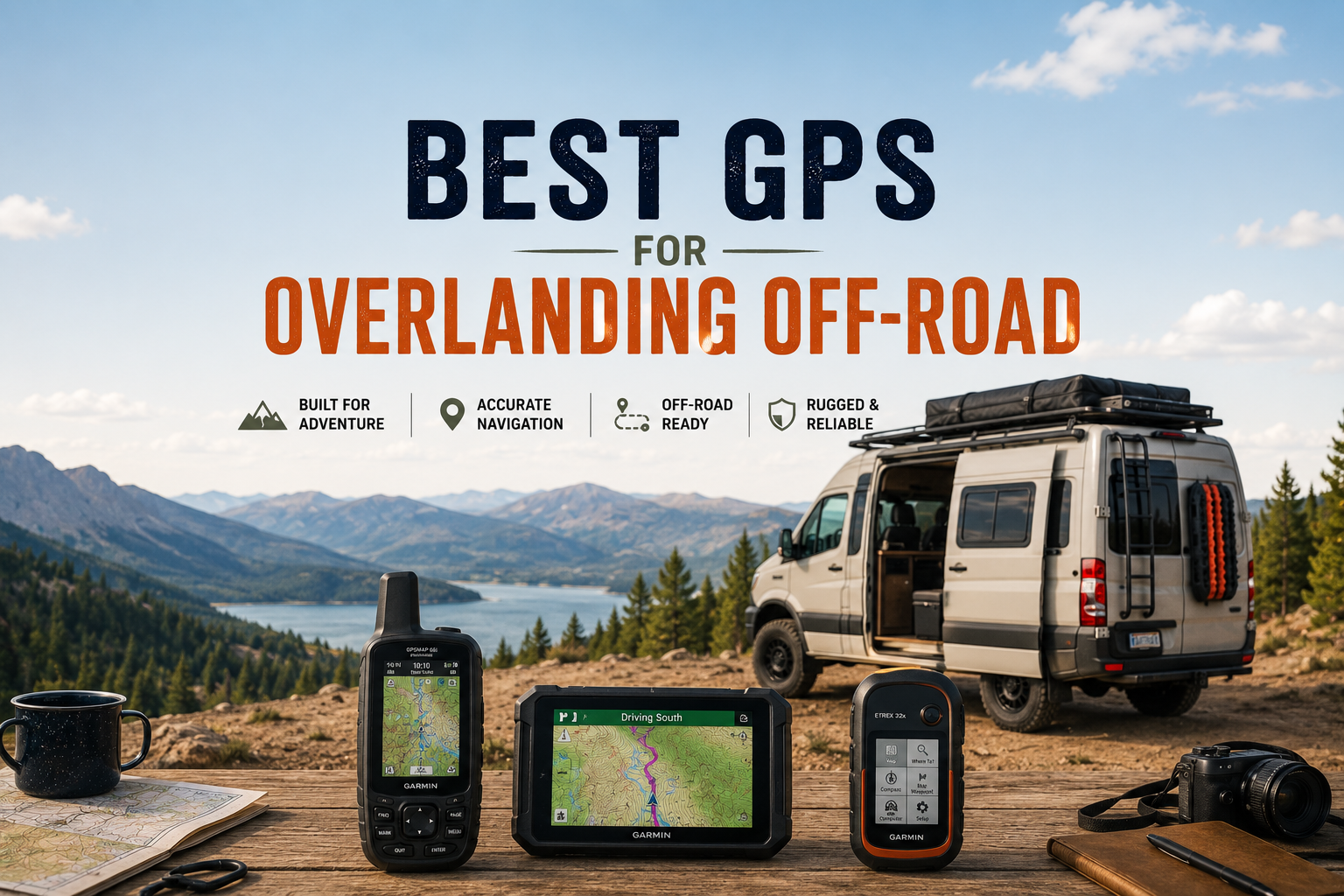
Best GPS for Overlanding Off-Road 2026: Top 5 Picks
Smartphone apps are great for city driving, but they buckle under the pressure of real overlanding: no signal, battery drain, and fragile hardware that can’t survive a dusty, bone-rattling trail. You need a purpose-built device that loads topographic maps offline, tracks your route in real time, and survives whatever the wilderness throws at it.
We’ve researched the top-rated, most current overlanding GPS units on the market to bring you five picks that are genuinely worth your money. Whether you’re a weekend warrior or a full-time van lifer, this guide has you covered.
What to Look for in an Off-Road GPS for Overlanding
[IMAGE: topographic map GPS device rugged]
Not all GPS units are built for the backcountry. Before you spend your money, there are a few non-negotiable features that separate a true overlanding navigator from a glorified car GPS.
Offline maps and topographic data are the foundation of any good overlanding GPS. You need detailed topo maps, trail networks, and public land boundaries loaded directly on the device — no cell signal required. Look for units that support BLM land, national forest roads, and pre-loaded trail data. Devices that allow you to download Garmin’s premium map packages or import custom GPX routes give you the most flexibility in the field.
Durability and display quality matter enormously when you’re navigating rough terrain. Look for MIL-STD-810G or IP67/IP68 ratings for dust and water resistance. A bright, glare-resistant touchscreen that you can read in direct sunlight — ideally 1,000 nits or higher — is essential. Some overlanders prefer physical buttons for gloved-hand use, so consider your typical conditions. Battery life, mount options, and Bluetooth/satellite messaging integration are also worth checking. For a deeper dive into GPS display technology, PCMag’s GPS navigator reviews are a solid reference.
Community features and route sharing have become increasingly important. Platforms like OnX Offroad and Garmin’s inReach ecosystem allow you to share waypoints, track your trip, and even send SOS signals via satellite. If you’re venturing into seriously remote territory — think Baja, the Outback, or deep wilderness — satellite communication capability could save your life. [INTERNAL LINK: best satellite communicators for van life]
Top 5 Best GPS for Overlanding Off-Road 2026
[IMAGE: off-road GPS devices lineup comparison]
—
1. Garmin Overlander — Best All-Around Overlanding GPS
[IMAGE: Garmin Overlander GPS mount vehicle]
The Garmin Overlander is the gold standard for serious off-road navigation. Designed from the ground up specifically for overlanding — not adapted from a car GPS — it comes pre-loaded with topographic maps, BLM and National Forest roads, and public land boundaries across North America. It’s one of the few dedicated GPS units that feels like it was built by someone who has actually gone overlanding.
The 7-inch sunlight-readable display is crisp and bright, and the unit pairs seamlessly with Garmin’s inReach satellite ecosystem, allowing you to send messages and trigger SOS even when there’s zero cell coverage. It also pairs with the Tread app for community-sourced trail reviews and route planning.
Key Specs:
- Display: 7-inch touchscreen, 1,024 x 600 resolution
- Maps: Pre-loaded North America topo, BLM, USFS roads
- Battery: Up to 2.5 hours (primarily wired use)
- Connectivity: Bluetooth, Wi-Fi, USB-C
- Durability: IPX7 water resistance
- Weight: 1.1 lbs
Pros:
- Purpose-built for overlanding with pre-loaded BLM and USFS data
- Pairs with Garmin inReach for satellite SOS messaging
- Large, bright display that’s readable in full sunlight
Cons:
- Short internal battery life — needs to stay plugged in
- Premium price point
- No built-in satellite communicator (requires separate inReach device)
Who it’s best for: Dedicated overlanders and van lifers who want the most complete, professionally designed off-road navigation system available and don’t mind wiring it into their rig.
—
2. Garmin inReach Messenger Plus — Best for Remote Safety and Navigation
[IMAGE: Garmin inReach Messenger Plus hiking]
The Garmin inReach Messenger Plus blends satellite two-way messaging with GPS navigation in a compact, handheld form factor. For van lifers and overlanders who venture into genuinely remote areas where being found matters as much as finding your way, this is the essential device. It’s not a full-featured in-dash navigator, but as a complement to your main setup — or as a standalone backcountry safety tool — it’s unmatched.
It uses the Iridium satellite network for global coverage, supports SOS with 24/7 monitoring, and can share your live location with people back home. The companion Garmin Explore app syncs routes and waypoints seamlessly.
Key Specs:
- Network: Iridium satellite (global coverage)
- Battery: Up to 28 days (10-minute tracking)
- Display: 1.3-inch color display
- Weight: 3.5 oz
- Durability: MIL-STD-810H, IP68
- SOS: 24/7 GEOS emergency response
Pros:
- Global satellite coverage — works absolutely anywhere on Earth
- Exceptional battery life for extended expeditions
- Extremely rugged and compact
Cons:
- Requires a monthly satellite subscription plan
- Small screen not ideal for detailed map navigation
- Works best as a supplement to a larger GPS device
Who it’s best for: Solo overlanders, remote van lifers, and expedition travelers who prioritize safety and two-way communication in areas with zero connectivity. [INTERNAL LINK: best van life safety gear for solo travelers]
—
3. Garmin GPSMAP 67i — Best Handheld GPS with Satellite Messaging
[IMAGE: Garmin GPSMAP 67i handheld trail]
The Garmin GPSMAP 67i is the best handheld option for overlanders who want full GPS navigation capability combined with inReach satellite messaging in a single device. Unlike the Overlander (which is primarily vehicle-mounted), the 67i is equally at home clipped to your pack when you leave the rig and explore on foot — making it an incredibly versatile piece of kit for true adventure travelers.
It supports multi-band GNSS (GPS, GLONASS, Galileo, and more) for exceptional positional accuracy even in deep canyons and dense tree cover. The button-based interface is perfect for gloved hands, and the 2.6-inch display is sharp and readable outdoors.
Key Specs:
- Display: 2.6-inch color, sunlight-readable
- Battery: Up to 165 hours (GPS mode)
- GNSS: GPS, GLONASS, Galileo, BeiDou, QZSS
- Satellite messaging: Yes (inReach built-in)
- Durability: MIL-STD-810H, IPX7
- Weight: 7.8 oz
Pros:
- Best-in-class multi-band GNSS accuracy
- Built-in inReach satellite messaging — all in one device
- Exceptional battery life for multi-day trips
Cons:
- Smaller screen than vehicle-mounted units
- Satellite subscription required for inReach features
- Price is high for a handheld unit
Who it’s best for: Overlanders who regularly leave their vehicle to hike, bike, or explore on foot and want a single device that handles both in-vehicle navigation and backcountry trekking.
—
4. OnX Offroad Premium Subscription + Tablet Mount Setup — Best Software-First Solution
[IMAGE: OnX Offroad app tablet off-road]
OnX Offroad takes a different approach to overlanding navigation — rather than proprietary hardware, it delivers the industry’s most comprehensive trail database through a subscription app that runs on your existing tablet or phone. When paired with a rugged tablet mount and an offline-capable device, the OnX Offroad Premium tier delivers maps that many hardcore overlanders consider superior to any dedicated device for trail discovery and community data.
OnX’s database includes over 500,000 miles of mapped trails, real user reviews, public land data, and property boundary overlays. The offline download feature means you’re covered without cell signal. For van lifers who already carry a tablet, this is often the most cost-effective and feature-rich solution.
Key Specs:
- Platform: iOS and Android app
- Subscription: ~$29.99/year (Premium tier)
- Trails: 500,000+ miles of mapped off-road routes
- Offline: Full offline map downloads
- Public land data: BLM, USFS, state land boundaries
- Community features: Trail reviews, photos, ratings
Pros:
- Largest curated off-road trail database available
- Highly affordable compared to dedicated hardware
- Constantly updated with community-sourced trail data
Cons:
- Relies on phone/tablet hardware — battery management is critical
- No built-in SOS or satellite communication
- Requires annual subscription to maintain access
Who it’s best for: Budget-conscious van lifers and overlanders who already have a quality tablet setup and want the most trail-rich mapping experience without investing in dedicated hardware.
—
5. TomTom GO Expert Plus — Best for International Overlanding Routes
[IMAGE: TomTom GO Expert Plus truck GPS]
The TomTom GO Expert Plus earns its spot on this list for overlanders and van lifers who regularly cross borders or need detailed road and route data beyond North America. While Garmin dominates the pure off-road trail space, TomTom’s GO Expert Plus excels at long-distance expedition routing — particularly for those driving converted vans, campers, or expedition vehicles with specific size and weight parameters.
You can input your exact vehicle dimensions, weight, and cargo type, and the GO Expert Plus will route you accordingly — avoiding low bridges, weight-restricted roads, and ferry restrictions. The 7-inch display is large and responsive, and lifetime world map updates are included at no extra cost.
Key Specs:
- Display: 7-inch HD touchscreen
- Maps: Lifetime world map updates included
- Vehicle profiles: Custom size, weight, cargo type
- Traffic: Real-time via Wi-Fi
- Durability: Standard in-vehicle use
- Connectivity: Bluetooth, Wi-Fi
Pros:
- Custom vehicle profile routing — essential for vans and campers
- Lifetime world maps with no subscription required
- Large, responsive 7-inch touchscreen
Cons:
- Less specialized for trail-level off-road navigation than Garmin
- No satellite messaging or SOS capability
- Not waterproof or ruggedized for handheld outdoor use
Who it’s best for: Van lifers and expedition overlanders doing international or cross-continent trips in larger vehicles who need smart routing around vehicle restrictions.
Comparison Table: Best GPS for Overlanding Off-Road 2026
[IMAGE: GPS comparison chart overlanding gear]
| Product | Best For | Display | Satellite Messaging | Battery Life | Waterproof | Price Range |
|---|---|---|---|---|---|---|
| Garmin Overlander | All-around overlanding | 7-inch touchscreen | Via paired inReach | 2.5 hrs (wired use) | IPX7 | $$$ |
| Garmin inReach Messenger Plus | Remote safety & SOS | 1.3-inch color | Yes (built-in) | Up to 28 days | IP68 | $$ |
| Garmin GPSMAP 67i | Handheld + satellite combo | 2.6-inch color | Yes (built-in) | Up to 165 hrs | IPX7 | $$$ |
| OnX Offroad Premium | Trail discovery & mapping | Phone/tablet | No | Device-dependent | Device-dependent | $ |
| TomTom GO Expert Plus | International van routing | 7-inch HD touchscreen | No | Wired use | Standard only | $$ |
How to Choose the Right Off-Road GPS for Your Overlanding Style
[IMAGE: overlander studying trail map campsite]
The biggest mistake most people make is buying a GPS for overlanding based on specs alone without thinking about how they actually travel. A 7-inch in-dash unit like the Garmin Overlander is phenomenal if you’re spending most of your time navigating from the driver’s seat of a van or 4×4. But if you’re constantly jumping out of the vehicle to hike side trails, a handheld like the GPSMAP 67i or a lightweight inReach device will serve you far better in the long run.
Consider your risk profile honestly. If you’re doing weekend trips on well-traveled trails within an hour of civilization, OnX Offroad on your phone is genuinely all you need — and it offers the richest trail database of anything on this list. But if you’re running remote routes in Baja, navigating remote Alaskan roads, or crossing international borders solo, satellite messaging capability isn’t optional. The ability to send an SOS or a simple “I’m okay” message to someone who cares could be the most important feature on your entire gear list.
Finally, don’t underestimate the value of a system that works together. Many serious overlanders run a combination: a dedicated in-vehicle GPS for navigation, paired with a handheld inReach device for communication. The redundancy isn’t paranoid — it’s professional. The best overlanders plan for failure, and having two independent ways to know where you are and communicate your position is what separates experienced adventurers from those who end up on the news for the wrong reasons.
Frequently Asked Questions About the Best GPS for Overlanding
[IMAGE: overlanding camp navigation planning night]
Do I really need a dedicated GPS for overlanding, or will my phone work?
Your phone can work for light overlanding on popular trails with good offline map apps like OnX Offroad or Gaia GPS. However, phones have real limitations in the backcountry: battery life drains fast with GPS active, screens wash out in sunlight, and they’re not built for dust, vibration, or water exposure. For serious off-road adventures — especially in remote or international locations — a dedicated GPS or a satellite-capable device like the Garmin inReach is strongly recommended as a backup or primary device.
What’s the difference between Garmin Overlander and Garmin inReach?
The Garmin Overlander is a vehicle-mounted navigation GPS designed specifically for off-road driving, featuring a large 7-inch screen and pre-loaded topographic maps. The Garmin inReach is a satellite communicator with basic GPS functionality that allows two-way messaging and SOS alerts via the Iridium satellite network. They’re designed to complement each other — the Overlander navigates, the inReach keeps you connected and safe. Some overlanders use both together for a complete system.
Is OnX Offroad good enough for serious overlanding?
OnX Offroad is genuinely excellent for trail discovery, route planning, and accessing public land data — and many hardcore overlanders use it as their primary mapping platform. Its database of 500,000+ mapped trails is the largest available anywhere. However, it depends entirely on your phone or tablet’s hardware, battery life, and durability. For serious remote overlanding, pair OnX with a dedicated satellite communicator and a portable power bank to cover the gaps that a software-only solution cannot address.
Do overlanding GPS devices work internationally?
Most dedicated GPS devices work internationally in terms of satellite positioning — GPS satellites are global. However, the quality of your maps depends on what’s pre-loaded or downloaded. Garmin devices generally include North America maps out of the box with paid options for other regions. The TomTom GO Expert Plus includes lifetime world map updates, making it one of the best options for international overlanding and expedition travel across multiple continents.
What does IP67 or IPX7 mean for a GPS device?
These ratings describe water and dust resistance. IP67 means the device is fully dust-tight and can withstand submersion in up to 1 meter of water for 30 minutes. IPX7 means water resistance at the same 1-meter depth but without a formal dust-resistance rating (though most devices with this rating are still very dust resistant in practice). For overlanding, look for at least IPX7 as a minimum — your GPS will encounter rain, stream crossings, and dusty trails that would destroy an unrated device.
Final Verdict: Best GPS for Overlanding Off-Road 2026
[IMAGE: overland vehicle sunset trail adventure]
Choosing the best GPS for overlanding off-road 2026 comes down to how far you go and how prepared you want to be when things don’t go as planned. For most van lifers and overlanders, the Garmin Overlander remains the gold standard — purpose-built, loaded with off-road data, and ready to pair with satellite communication. If budget is a priority, OnX Offroad Premium delivers extraordinary trail data at a fraction of the cost. And for anyone venturing truly remote routes solo, adding a Garmin inReach device to your setup isn’t optional — it’s essential. Adventure boldly, but navigate smart.